
If you are moving to Miami from another city or country, you may have only a weekend to see homes. Filling every hour with tours can feel productive. A better first step is to decide what a location and a home must do for your everyday life.
Choose two areas to investigate first and keep a third as a genuine alternative. Start with the destination you visit most often, the kind of home you want and your move date. Remove any area that cannot meet a nonnegotiable need. A neighborhood should not stay on the list just because its photographs are compelling.
For a high-end primary home, settle the privacy, parking, access and service questions early. If you work in Brickell and want a serviced condominium, start there. If a private house and usable outdoor space matter most, look at specific Coconut Grove homes. If living by the ocean is essential, give Miami Beach a dedicated visit. These are starting points, not rankings. The actual address, building rules and trips you make can change the order.
The aim is to leave your visit with a clear shortlist rather than a collection of photos. The Ivan & Mike neighborhood guide can help you open the map. This guide helps you narrow it.
Start with the week you want to live, not the home that impresses you most
Imagine finding a beautiful residence. The layout and view seem right. Now picture a normal week: leaving for work, welcoming guests, exercising, traveling and returning late. A strong photograph cannot tell you how any of that will work.
Write down five details before choosing areas. They do not need to be perfect, but they should be specific enough to remove poor fits:
The office, campus or other address you will visit several times a week. Use an exact address rather than “near downtown.”
House, condominium or both. Add the rooms and features you need: privacy, a real office, outdoor space or building services.
Which airport you use, how often you fly and the usual departure and arrival windows. An occasional flight need not control the entire search.
When you need to live there, and whether renovation, new construction or a temporary transition is realistic.
Your investment range, expected ownership costs and firm requirements. A range filters current homes; it does not assign one price to an entire neighborhood.
Separate essentials from preferences. A closed office may eliminate an otherwise lovely condominium. An ocean view may be a preference rather than a requirement. Treating everything as essential makes the search impossible; treating nothing as essential makes it endless.
Turn those priorities into two or three areas
Begin with a broad list, then narrow it before booking tours. Use the neighborhood directory to find candidates. Apply three filters in order: daily use, home format and timing. If an area cannot meet a firm requirement for this trip, set it aside. You can return to it if your priorities change.
Use this table to choose where to focus first, then compare current homes that meet your requirements.
| If this is your priority | Where to begin | What to verify before a tour |
|---|---|---|
| Frequent work in Brickell and a preference for a condominium | Begin with Brickell condominiums that meet your essential requirements. | Compare two actual buildings: floor plans, parking rights, access rules, included services and the trip from each address to work. |
| A house, privacy and outdoor space you will use | Start with suitable Coconut Grove homes. | Review the floor plan, sightlines, grounds, maintenance and the trips to your regular destinations. |
| An oceanfront residence is essential | Include Miami Beach, selecting homes by address. | Confirm actual beach access, the building documents for a condominium, exposure at that address and your usual routes. |
If your family’s decision depends on a school campus and weekday schedule, use our separate Coconut Grove, Coral Gables and Pinecrest comparison. It examines that choice in more detail. Those three areas need not shape every relocation search.
A first look at the three settings
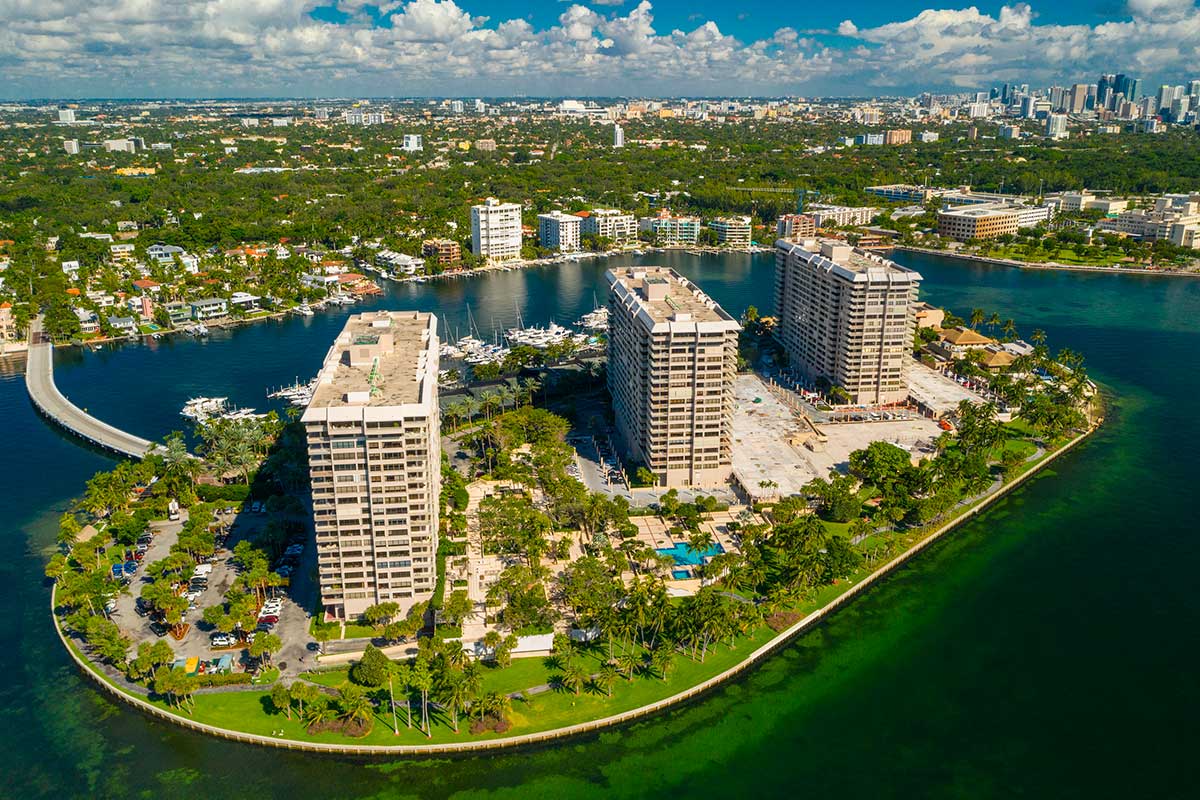
Photographs can help you picture the surroundings. The right home still depends on its exact address, layout and daily routes.


A rule that saves a wasted tour
Do not book a home simply because it is in the “right” neighborhood. First request a readable floor plan, confirm that its use works for you and locate the exact address. The area starts the search; the property earns its place on the calendar.
A practical checklist for a high-end home search
A high-end search gets clearer when you define how you want to live, entertain and travel. Apply these filters to each home before adding it to your itinerary. Each recommendation depends on the specific property; none is a blanket claim about Brickell, Coconut Grove or Miami Beach.
- 01
Privacy you can actually experience
Recommendation: begin with the arrival, views into the bedrooms and the practical use of terraces or a yard. In a condominium, request the floor plan, elevator access, guest procedures and service-delivery route. For a house, inspect the view from the street and adjacent properties, entrances and outdoor space.
To decide: visit at a normal time of day and read the building or community rules. A staffed gate alone does not establish privacy inside the home.
- 02
Parking that fits the cars you own
Recommendation: if two drivers will keep two cars, make two usable spaces a search requirement. Ask whether a space is deeded as part of ownership, assigned for your use or handled only by valet staff. Check dimensions, clearance, turning room and electric-vehicle charging rights if needed. Decide how guests will park, too.
To decide: request the plan and documents that show the parking rights. Remove a home if a necessary second space cannot be verified.
- 03
Controlled access that works day to day
Recommendation: if you want a controlled-access building or community, find out how guests, vendors and household staff enter, and whether deliveries or moves are restricted. Judge private access by how it will function in your life, not by a listing description.
To decide: ask for current rules and walk the entrance, parking area and common spaces. If you host often, test the full guest arrival from street to front door.
- 04
Amenities you will really use
Recommendation: name two or three services that matter to you: a gym, spa, pool, club, courts, concierge or marina. Establish whether each belongs to the building, requires a separate membership or is run by another provider. Ask about fees and reservations.
To decide: do not treat a club membership or boat slip as part of a home purchase without documents granting that right. Living near a marina does not provide a berth.
- 05
Shopping and social destinations you would choose
Recommendation: select real destinations before measuring convenience. Brickell City Centre is a retail reference in Brickell; Shops at Merrick Park is a useful comparison from Coconut Grove; and Bal Harbour Shops is a luxury-shopping destination to test from Miami Beach. None represents everyone’s routine.
To decide: choose two places you would visit monthly and check the route from each finalist home, not from the neighborhood label.
- 06
The airport, based on how often you fly
Recommendation: if you fly weekly, test the trip to Miami International Airport (MIA) from each candidate home during your normal departure and return windows. If you fly only occasionally, do not give up the home format or privacy you want for a theoretical difference in distance.
To decide: record the date, time, origin, terminal and estimated door-to-door trip. The map distances below help with orientation; they do not predict traffic.
- 07
The bay: a view, a walk or boating access
Recommendation: decide which of these you mean. For a waterfront walk, identify an actual public access point. For a view, inspect its direction and possible obstructions from the unit. For boating, verify marina rules and berth availability separately.
To decide: a nearby bayfront landmark proves neither a view nor access rights from a home.
- 08
Condition and ownership costs that support the choice
Recommendation: before committing to a building, review current fees, insurance information, special charges, reports and use rules. For a house, document condition, upkeep and any work needed. Check the county flood-zone map for the exact address.
To decide: if a decision-making document is missing or outdated, leave the home on hold until it can be checked. Do not fill that gap with an assumption.
Where to make the first cut
For a household with two cars, remove a condominium that can document only one necessary space. For weekly air travel, keep homes whose airport trip you can test at your normal hours. If the bay matters because you boat, separate homes with a view from homes with a verifiable boating right from the start.
Three small maps to place destinations in context
Each map begins at a named public reference point and shows MIA, a place by the water and a shopping destination. This helps you understand the scale of a possible search before you look at individual homes. Distances are approximate straight-line miles, not driving routes, traffic estimates or measurements from a residence. Open the route links when you have a candidate address.
Retail at the reference point; the bay to the south
Reference: Brickell City Centre, 701 S Miami Ave. It is also this example’s retail destination.
- MIA: about 6.3 straight-line miles. Check a current route.
- Bay reference: Alice C. Wainwright Park, about 1.5 straight-line miles. Check a current route.
Use it this way: Brickell City Centre may make regular shopping convenient. Verify whether a particular home also delivers the privacy and relationship to the bay you want.
The bay is close to this reference point
Reference: CocoWalk, 3015 Grand Ave. It is a public point of orientation, not a home address.
- MIA: about 5.5 straight-line miles. Check a current route.
- Bay reference: Dinner Key Marina, about 0.4 straight-line miles. Check a current route.
- Shopping: Shops at Merrick Park, about 1.2 straight-line miles. Check a current route.
Use it this way: tour Grove homes when privacy and a house are your priorities. Dinner Key’s proximity does not confirm a berth or direct access from any home.
Your location on the island changes the answer
Reference: Miami Beach City Hall, 1700 Convention Center Dr. It is one comparison point, not the center of every Miami Beach search.
- MIA: about 9.6 straight-line miles. Check a current route.
- Water and beach: South Pointe Park, about 1.7 straight-line miles. Check a current route.
- Luxury shopping: Bal Harbour Shops, about 6.6 straight-line miles. Check a current route.
Use it this way: do not apply these figures to every part of South Beach, Mid-Beach or North Beach. An oceanfront home elsewhere may have a very different trip to Bal Harbour or MIA.
Method: addresses published by MIA, venue operators and local governments; approximate street coordinates from the U.S. Census Geocoder and MIA’s airport reference point from the 2026 Florida Airport Directory. Straight-line calculations are rounded to 0.1 mile. Base map: USGS The National Map. These points are neither neighborhood boundaries nor navigable routes.
A focused shortlist that leads to a decision
Suppose you are moving to Miami to live year-round, work in Brickell several days a week and fly frequently through MIA. You have two days to tour. Privacy, two usable parking spaces and a move-in-ready home are essential; a garden would be a welcome extra.
Day one could focus on two Brickell buildings with suitable layouts, verified parking rights and acceptable rules. Coconut Grove would provide a meaningful contrast: does a particular house offer enough additional privacy and outdoor space to justify a different routine? Miami Beach belongs on the trip only if living by the ocean becomes a real priority. A third area need not take half a day simply to complete a list.
| Need | Where to begin | Evidence to request | Provisional decision |
|---|---|---|---|
| Several weekly trips to a Brickell office | Brickell | Two current home addresses, parking documents and comparable morning and return routes. | Tour suitable homes first; do not assume the journey works. |
| More privacy and usable outdoor space | Coconut Grove | Floor plan, property condition, grounds and an in-person visit to each finalist house. | Tour as a contrast if a suitable house is available. |
| A home by the ocean | Miami Beach | A suitable home address, actual beach access and the building's rules. | Leave out of this trip while it remains a preference. |
Before traveling, request the proof needed to rule out a poor fit. After each tour, write down the one document or check that could still change the decision.
Compare the trips you would actually make
“Coconut Grove to Brickell” is not a useful trip measurement. Start with two exact doors: the home and the destination. Compare each candidate using the same departure time, day of the week and way of traveling. Check the return journey as well.
If you fly frequently, add the airport you use and the part of the trip that matters to you. MIA publishes its ground-transportation pickup information. That helps plan an arrival but does not give a door-to-door estimate from a home. Do not turn a straight-line distance into “usual driving minutes.”
A fair comparison fits on one line
Home address → exact destination · Tuesday at 8:00 a.m. · car · date checked · estimated time. Repeat that line for each home. If you make the trip, record your observed time separately. An estimate and one experience are not historical averages.
What to request before you travel
When your visit is short, remove a home that cannot meet the essentials before it reaches the itinerary. Request current information detailed enough to show what you still need to inspect in person:
- Current listing status. Confirm availability, tour conditions and when the information was updated. An old screenshot is not enough.
- A floor plan that shows how the home works. Look for bedrooms, circulation, office space, terraces, parking and the rooms you will use. Photos cannot settle the layout.
- Property rules and costs. For a condominium, request current association documents, budget, fees, possible special assessments (additional charges to owners), insurance information and restrictions that affect your plans. Florida’s condominium regulator describes the records and reports to review. Analyze the documents for the building in question, not a brochure for another one.
- Address-specific public checks. Start with the Miami-Dade property search and the county’s flood-zone map. The property appraiser warns that its data may not be current. A flood designation alone does not determine insurance cost or availability.
- Building status where relevant. Miami-Dade’s guidance on periodic building recertification explains that the responsible authority depends on jurisdiction. A missing record in the county search does not prove a building has no obligation. Confirm the local authority and request applicable reports.
This early review helps you spend your visit well. Before signing, legal, tax, insurance, structural and financing decisions require current documents and the appropriate qualified professionals. An initial shortlist is not purchase approval.
Use two days without turning the visit into a race
Your itinerary will depend on the length of your trip and the homes actually available. Still, grouping visits by area leaves room to experience the surroundings. Five back-to-back tours with no pause to compare them can create a false sense of progress.
Before you arrive: confirm the list
Choose two primary areas, one alternative and only a few homes that have passed the basic document check. Keep the addresses, reason for each visit and remaining decision point on one page.
First block: test the most likely area
Tour comparable homes and check the route from each to your regular destination at a realistic hour. Notice the arrival, building or street, interior and spaces you will use. Leave time to return to a finalist.
Second block: seek a real contrast
Give the second area time for a clear reason: a different home format, more privacy or a different daily routine. Apply the same checks so the comparison stays fair.
Final block: decide what deserves follow-up
Mark every home “continue,” “remove” or “await a document,” with a reason. If the third area solves no new need, you do not have to tour it just to complete the itinerary.
Confirm each appointment and compare routes from the actual addresses at the hours that matter to you.
Three options, one clear next step
Apply the same four filters to each home before scheduling tours. The focused shortlist shows which evidence to collect for each candidate.
Use the same standard for every candidate
- 01Fit
Keep only homes that meet your essential requirements.
- 02Proof
Ask for the address, plan or document behind each claimed advantage.
- 03Date checked
Record when each important fact was confirmed.
- 04Decisive check
Name the one outstanding fact that could change your choice.
01 / Priority
Tour
The home meets the essentials and gives you a specific reason to visit.
Request the plan, current status and documents that could change your decision.
02 / Contrast
Tour with a purpose
It offers a different way to live and could outperform your first choice on a priority.
Define the advantage it must demonstrate; apply the same checks and route method.
03 / Reserve
Wait
For now it meets a preference but does not improve an essential need or offer a convincing home.
Identify the new requirement or particular property that would justify a tour.
Result: two options you know why you are visiting, plus a third that enters only when it adds something new. A reserve option can become a priority when the evidence changes.
When to change your mind
A shortlist works while its assumptions still hold. If your office changes, a school campus is confirmed, a building prohibits an important use or a house needs work that conflicts with your move date, apply the filters again. Do not defend an area that no longer serves the decision.
The opposite can happen: an exceptional home outside your original list may deserve a look. Compare it with the finalists using the same criteria. An exception should earn its place with evidence, not the excitement of one afternoon.
Three straight answers before you pack
Can I narrow the list without traveling?
Yes. You can remove areas that cannot meet your home format, move date or fixed destination, and skip homes without adequate plans or documents. You cannot confirm from afar how a particular street, entrance or daily routine will feel.
Should I choose the building or the area first?
Start with a small set of workable areas, then compare real buildings or houses within them. Starting with one striking building can make you bend your life around its photographs. Choosing an area without checking actual homes can leave you pursuing a format that is not available when you need it.
What should be settled after the visit?
You should know which one or two homes deserve deeper review, why the others were removed and what document remains for each finalist. You need not sign during the trip. Leave with a shortlist, clear reasons and specific next checks.
Your next step can be small and specific
Use the neighborhood guide to choose two areas that meet your requirements. Apply the checklist above to actual homes. If you want to organize a focused visit around current properties and exact addresses, talk with Ivan & Mike about your shortlist.
Sources and limits of this guide
Public sources were checked on October 28, 2026. Use property-specific documents and current availability to decide which homes to tour, and recheck venue offerings and rules before relying on them. Map distances are approximate straight lines between public references; they are not routes from a home. The MIA point is FDOT’s airport reference point, not a terminal entrance. Street coordinates from the Census geocoder may be interpolated.
- Miami-Dade Property Appraiser: Property Search, property lookup and data limitations.
- Miami-Dade: Flood Zone Maps, address-specific research.
- Florida DBPR: Condominium Information & Resources, association records.
- Miami-Dade: Recertification, scope of the responsible authority.
- MIA: Ground Transportation and airport address; FDOT’s 2026 Airport Directory for its reference point.
- Brickell City Centre, CocoWalk, Shops at Merrick Park and Bal Harbour Shops, operator-published locations.
- City of Miami: Alice C. Wainwright Park and Dinner Key Marina; City of Miami Beach: South Pointe Park and City Hall.
- U.S. Census Geocoding Services, approximate street coordinates; USGS The National Map, map tiles.
- Ivan & Mike: South Florida Neighborhoods, the broader area directory.