
Our recommendation: do not begin by asking which community is “the most private.” Begin by defining what you need to keep separate: the street, neighboring properties, shared areas, visitors, the daily operation of the home, or the information that circulates during a purchase.
A controlled entrance may help with one part of access. It does not tell you whether another residence looks onto the terrace, how many people share the elevator, where household staff and vendors arrive, how sound travels through the property, or which photographs remain online. Before building a shortlist, turn your priorities into five nonnegotiable requirements and apply the same test to every property.
Our six-layer privacy framework: we compare every property through street exposure, views, arrival, sound, daily operations and information, then give each requirement an A, B or C priority. The method starts with the buyer’s nonnegotiables; an authorized visit and current documents establish how a particular property actually works.
A useful definition
Privacy is not one feature; it is a chain of decisions
Two properties can both be described as gated and still produce entirely different experiences. The clearest comparison separates privacy into six layers.
Public exposure
What can be seen from a sidewalk, road, public access point, or property across the way.
Relationship to neighbors
How windows, terraces, pools, gardens, and the spaces your family uses most face nearby properties.
Access and circulation
Which parts of the route are shared by residents, guests, staff, valet teams, elevators, or corridors.
Acoustic separation
What can be heard from the street, common areas, adjacent properties, terraces, or service zones.
Daily life
How vendors, deliveries, household staff, maintenance teams, guests, and management enter and move through the property.
Digital exposure
Which address details, photographs, floor plans, showing schedules, or transaction information need specific handling instructions.
The result should never become a public safety ranking. It is a private comparison between the buyer’s requirements and the evidence available for each property.
The first assumption to remove
Controlled access answers who crosses a boundary; it does not explain privacy inside
A community or building with controlled access can be an excellent fit when the arrival model supports the buyer’s life. Yet the word gated describes only one feature. Before making it a pass-or-fail criterion, understand what happens after that first boundary.
What to confirm
- Which entrance residents, guests, and vendors use.
- Which documented rules apply to visitors and common areas.
- Which circulation remains shared before reaching the residence.
- Who administers the rules and where they are written.
What still needs proof
- Views into and out of private spaces.
- The acoustic experience indoors and outdoors.
- The relationship between a terrace or garden and neighboring properties.
- Compatibility with staff, deliveries, and maintenance.
Practical rule: if a property’s privacy case depends entirely on the gate, almost everything inside still needs to be evaluated.
The format changes the questions
A house is not always more private than a condominium
A house may offer more control over the lot, landscaping, and arrival. It may also be more exposed when its primary rooms face the street or a neighboring property. A condominium may place several layers between the street and the residence, while still requiring a shared lobby, elevator, corridor, service route, or nearby terraces.
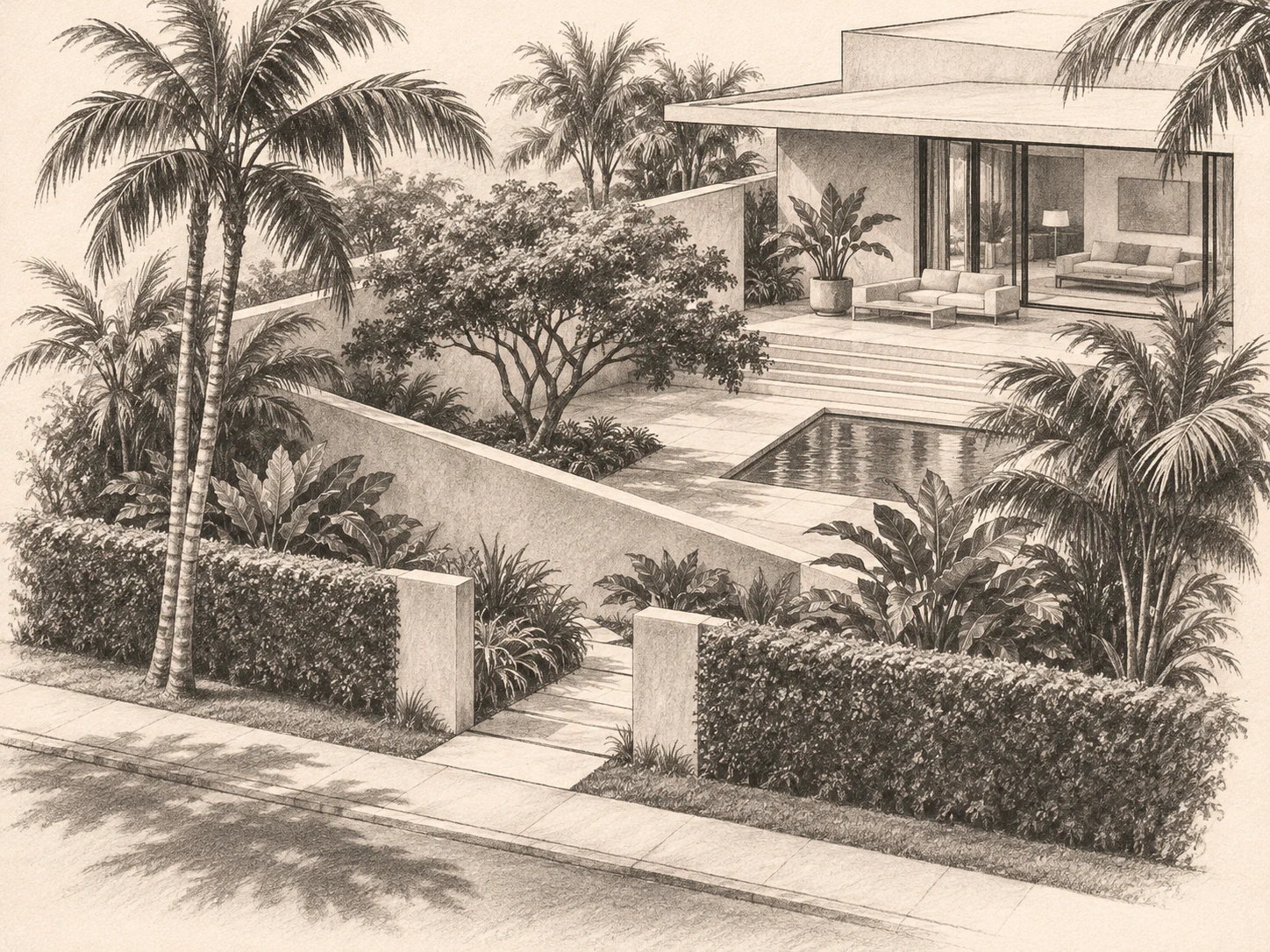
Compare the lot, views, and daily operation together
Review the setback from the street, the orientation of primary rooms, neighboring properties, the service route, and how the garden, pool, and exterior spaces will be maintained.
The decisive test: stand in every space you would actually use. Do not infer privacy from lot size.
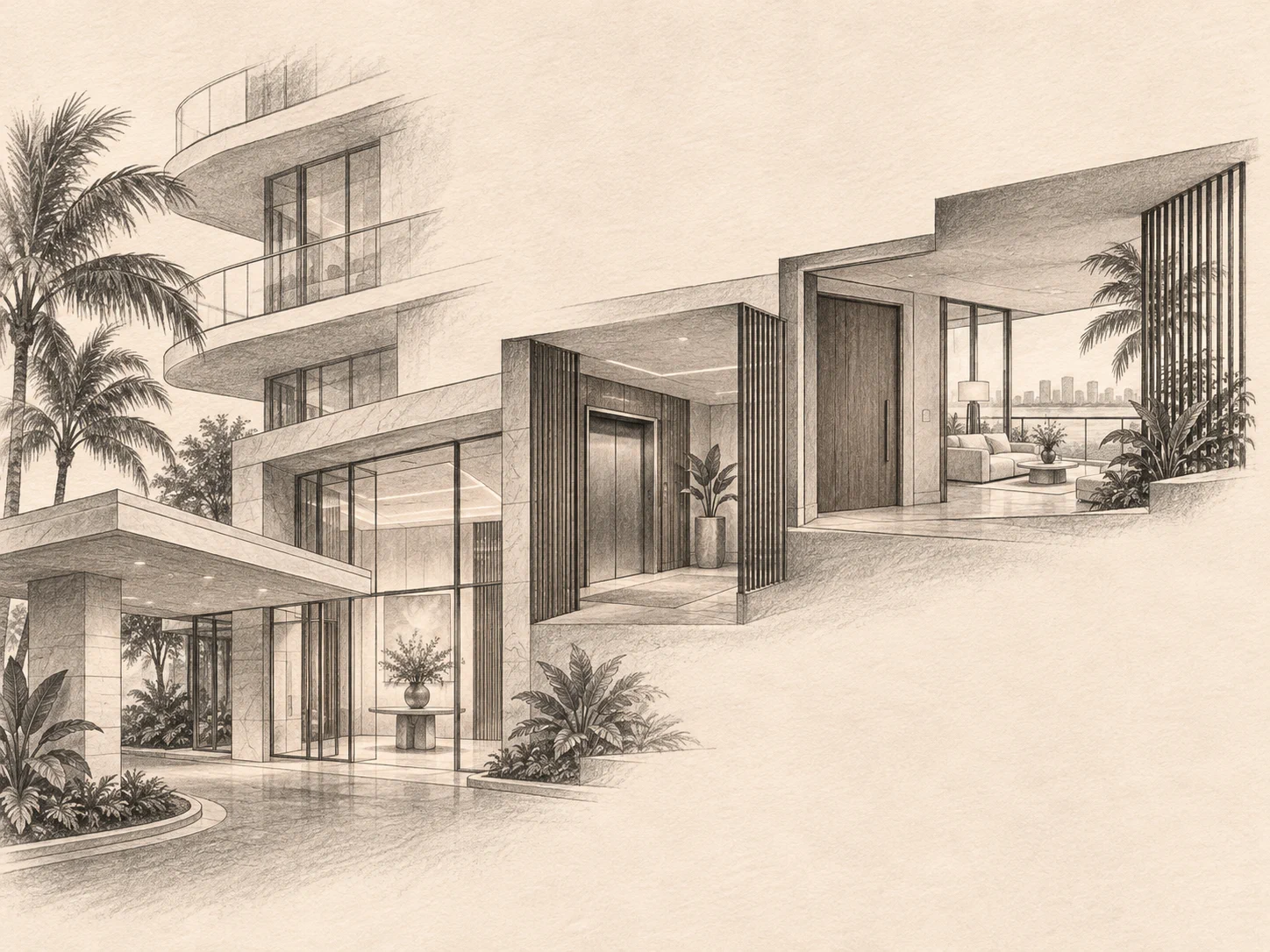
Follow the complete route to the residence
Compare arrival, valet or parking, lobby, elevator, private foyer, service entrance, terrace placement, and the rules for guests, staff, and vendors.
The decisive test: request the current documents that govern use. A sales presentation does not replace the building’s rules.
Florida’s Division of Condominiums lists declarations, bylaws, current rules, meeting minutes, management agreements, and other operating records among relevant association records. Request the documents that apply to the property and obtain appropriate advice about their meaning. [3]
Research before a visit
You can eliminate poor fits without turning the search into an invasive investigation
The purpose of this stage is to reduce unnecessary travel and tours. It is not to search for access codes, resident identities, private routines, or sensitive operating details. The goal is to gather public or authorized information that shows whether a property deserves a deeper inspection.

Begin with the correct property
Miami-Dade Property Search provides address, folio, property characteristics, sales, aerial imagery, and available sketches. Use the record as a starting point and confirm information that matters to the decision. [1]
Confirm where it is and what surrounds it
Miami-Dade e-Maps supports searches by address or folio and displays municipal and other GIS layers. Use it to orient the search, not as a survey or final proof of a view or boundary. [2]
Request restrictions, rules, and obligations
For purchases subject to Chapter 720, Florida’s disclosure summary identifies association membership, recorded restrictions, assessments, and possible special assessments. It is a starting point; the full governing documents explain how the community operates. [4]
Review shared life in the documents
Request the declaration, bylaws, current rules, question-and-answer sheet, budget, and other relevant records. For privacy, focus on circulation, guests, vendors, common areas, and management procedures. [3]
Authorized floor plans, current photographs, and a well-directed video call can show orientation and the relationship between spaces. Even so, marketing imagery cannot establish what you will see, hear, or share from the home. Keep those points open until the visit.
Decision tool
Turn “I want privacy” into a matrix that can actually filter properties
Before comparing addresses, assign a priority to each requirement. A property remains on the list only when it meets every nonnegotiable item or offers a specific solution you would accept.
If it fails, the property leaves the list even when it excels elsewhere.
A different solution may work if it preserves the experience you want.
Useful for choosing between finalists, but never a substitute for an essential need.
| Requirement | What I need | Before the visit | At the property |
|---|---|---|---|
| Street exposure | Name the spaces that should not sit in a direct sight line from a public road or entrance. | Parcel record, aerial imagery, and authorized materials. | Look from the entrance, living areas, bedrooms, and principal outdoor spaces. |
| Neighboring views | Identify where visual separation matters: pool, garden, terrace, or interior rooms. | Orientation, adjacent properties, and recent photographs. | Check the real angles in both directions. |
| Arrival | Describe how family, guests, and a driver should arrive. | Arrival plan and an authorized explanation of the route. | Follow the complete journey from the road to the front door. |
| Shared circulation | Define how much shared lobby, elevator, corridor, or access is acceptable. | Authorized plans, rules, and building format. | Count the shared transitions and observe how they are used. |
| Staff and vendors | Describe the home’s daily operation without publishing schedules or identities. | Management rules and the authorized service route. | Confirm that operations do not intrude on family spaces. |
| Outdoor spaces | Name the areas you will use and the separation you expect. | Orientation, photographs, and the relationship to nearby lots or terraces. | Spend time in each area and review views, sound, and circulation. |
| Sound | Define which rooms and times of day require the most calm. | Known nearby sources and documented construction details when available. | Listen with equipment off; repeat at another authorized time if it becomes a finalist. |
| Information and marketing | Define which details, images, and communications require special instructions. | Agree on channels, recipients, and document handling. | Avoid unauthorized photography or distribution. |
Shortlist decision: keep, keep with one specific condition, or remove. “It may be private” is not a fourth category.
A purposeful visit
Walk every property in the same order
A tour becomes more useful when you repeat the same method. That lets you compare real experiences instead of allowing one dramatic view or finish to control the entire decision.
Begin before you enter
Observe the approach, where a vehicle stops, and which parts of the home appear along the route.
Follow every shared space
Walk through reception, lobby, elevator, corridor, courtyard, or any transition used by other people.
Test the important rooms
Sit where your family would work, rest, or entertain, and look outward before evaluating the decor.
Look in both directions
From the pool, garden, or terrace, identify what you see and the points from which those spaces may be visible.
Picture an ordinary day
Locate deliveries, maintenance, staff, waste, pets, guests, and parking without recording sensitive details.
Decide before the next tour
Record the evidence, open questions, and one condition for keeping the property. Then compare it through the same matrix.
A visit shows one hour under one set of conditions. If a property becomes a finalist, repeat the checks that matter at another authorized time and review the documents before making the final decision.
Privacy beyond architecture
Information handling also needs a clear plan
For a buyer, this begins with a simple agreement: what information the team needs, who should receive it, and which channels will be used. Preferences involving identity, schedule, purchasing structure, or motivation should not be assumed. Discuss them and, when appropriate, document them within the applicable professional relationship.
Florida law defines different duties for different brokerage relationships. A transaction broker’s duties include limited confidentiality, unless waived in writing, for specified negotiating details, motivation, and other information a party asks to keep confidential. Understand the relationship and its limits in writing; this guide is not a substitute for that professional explanation. [6]
It is also important to separate privacy from commercial invisibility. NAR policy defines options such as office exclusive and delayed marketing, subject to seller certifications and local MLS rules. They affect exposure and cooperation; they do not promise that a transaction can remain outside every required record or disclosure. [5]
A useful question for any adviser: “What information needs to circulate for the search to work well, and what can remain limited within the applicable rules?”
The priority changes with use
Where we would begin, based on how you plan to use the home
Begin with the spaces your family will use every day
Prioritize views between properties, the real use of a garden or terrace, guest arrival, parking, and household operations that do not intrude on family spaces.
Begin with care during your absences
Compare who enters, with what authorization, and for which task; how deliveries and maintenance work; and which documents govern those processes. Our Bal Harbour and Surfside second-home guide develops that location decision.
Begin with information, arrival, and shared areas
Define communication instructions, showing schedules, and document distribution. Then filter properties through the complete arrival sequence, not simply the name of the neighborhood.
Separate privacy from boating feasibility
A secluded house or a residence with a view does not establish dock rights, depth, or route. Use this matrix for privacy and our Miami waterfront guide to examine how you would use the water.
Direct answers
What to resolve before requesting properties
Does a controlled entrance guarantee privacy?
No. It may organize one access point, but privacy also depends on views, shared circulation, sound, daily operations, rules, and information.
Is a condominium always less private than a house?
No. A condominium may provide a well-managed arrival and very little shared circulation. A house may be exposed from the street or neighboring lots. Compare specific properties.
Can I evaluate privacy before traveling to Miami?
You can remove poor fits using parcel information, authorized plans and materials, association documents, and a directed video call. Real views, sound, and the circulation experience remain open until the visit.
Which Miami neighborhood is the most private?
There is no responsible answer that works for everyone. Different areas include houses, condominiums, islands, controlled-access communities, and open streets. Define the requirement first, then find properties that can demonstrate it. Use our South Florida neighborhood guide to compare lifestyle and location. For controlled-access options in Coral Gables, review our gated-community guide and apply this article’s matrix to each property.
The next action
Bring five requirements to the first conversation, not five community names
Write down your five nonnegotiable conditions, classify each by layer, and identify the evidence you would accept. An adviser can then build a discreet, defensible shortlist without assuming that every property in one neighborhood works the same way.
Build a location shortlist around your requirements
Use our broader guide to compare locations, then speak with Ivan and Mike about the property formats that best support how you want to live in Miami.
Verification notes for legal and property facts
Why these links are here: our six-layer framework and recommendations organize the privacy search. The references below have a narrower role: they verify parcel tools, legal requirements, association records and information practices. For a finalist, current documents, an authorized visit and the appropriate professionals determine the property-specific answer. Public facts checked November 11, 2026.
View the public references used for factual verification
- Miami-Dade County Property Appraiser — Property Search. Property search and key characteristics; checked November 11, 2026.
- Miami-Dade County — e-Maps Viewer. Address, folio, municipality, and GIS-layer tools; checked November 11, 2026.
- Florida Department of Business and Professional Regulation — Condominiums & Cooperatives FAQs. Condominium association records and governing documents.
- Florida Statutes §720.401. Disclosure summary for prospective purchasers subject to homeowners’ association membership.
- National Association of REALTORS® — Multiple Listing Options for Sellers. Office-exclusive and delayed-marketing definitions and disclosures; specific implementation remains subject to local MLS rules.
- Florida Statutes §475.278. Authorized brokerage relationships, duties, and the scope of confidentiality.