
Our recommendation: do not buy for a hypothetical future buyer you cannot identify. Buy a home that works exceptionally well for you, then test whether its strongest qualities are understandable, documentable, and useful to more than one very narrow buyer profile.
We begin with five questions: who could reasonably buy this property later, what makes it easy to compare, which obligations travel with it, what could slow a future transaction, and what would make it difficult to replace. Recent appreciation alone cannot answer any of them. A disciplined review combines comparable transactions, current competition, property records, ownership documents, and the physical experience of the home.
Our resale-evidence framework: we evaluate buyer-pool breadth, comparability, ownership friction, physical differentiation, and competing supply. The result is not a price forecast. It is a clearer way to decide how much flexibility a property may offer if your plans change.
The decision behind the numbers
Future resale is not one metric; it is the interaction of five factors
A beautiful property can remain a strong personal choice even when its future buyer pool is narrow. The important step is knowing that before you purchase, rather than discovering it when you need to sell.
Audience breadth
How many realistic buyer profiles can use the location, format, layout, access, and ownership structure.
Comparability
Whether similar closed transactions exist and can be compared without mixing unlike properties.
Obligations
Rules, recurring costs, approvals, inspections, reserves, or use restrictions that a future buyer must accept.
Differentiation
Qualities that are difficult to reproduce: a coherent floor plan, protected view, privacy, water access, land, or service.
Competition
The number and quality of substitute properties a future buyer could choose instead.
These factors organize a buyer conversation; they are not a scoring model or an investment-return calculation.
First build the right cohort
A comparison is only useful when every property belongs in the same conversation
Market averages are tempting because they look decisive. Yet a South Florida luxury market can contain oceanfront condominiums, branded residences, historic estates, new construction, canal-front homes, and properties with entirely different service or ownership structures. Combining them can produce a number that describes none of them well.

Keep constant where possible
- Property format and ownership structure.
- Geography that matches the buyer’s real alternatives.
- Size, bedroom utility, parking, outdoor space, and condition.
- Water relationship, view, service level, and building generation when material.
- Observation period and the definition of every metric.
Make every mismatch visible
- A renovated residence compared with an unrenovated one.
- A direct-waterfront property compared with a water-view property.
- A developer sale compared with a resale.
- A branded residence compared with a conventional condominium.
- A rare estate compared with a larger but less functional property.
Practical rule: if we have to explain away most of the differences, the group is too broad. If only one transaction remains, the evidence is sparse and the decision requires more judgment—not a stronger claim.
The evidence file
Read closed evidence, live competition, and ownership obligations together
No single source explains future marketability. We organize the review into three files and keep their dates, definitions, and limitations visible.
What comparable buyers actually completed
Record the comparable group, closed-sale period, number of observations, condition differences, and the selected price measure. A public tax record can help confirm a recorded sale, but assessed value is not a current market valuation. [1]
What a buyer can choose today
Use an authorized listing source to review active and pending alternatives at one stated cutoff. Asking prices are current proposals, not closed evidence. Withdrawn, expired, new-construction, and resale inventory should not be silently mixed.
What transfers with the property
Request the documents that govern use, recurring obligations, building condition, reserves, approvals, and association operations. A future buyer evaluates the home and the structure around it. [3]
We would rather present an incomplete but honest comparison than a precise-looking ratio built from mismatched properties.
The property changes the risk
Apply the same framework, then adjust the evidence to the format
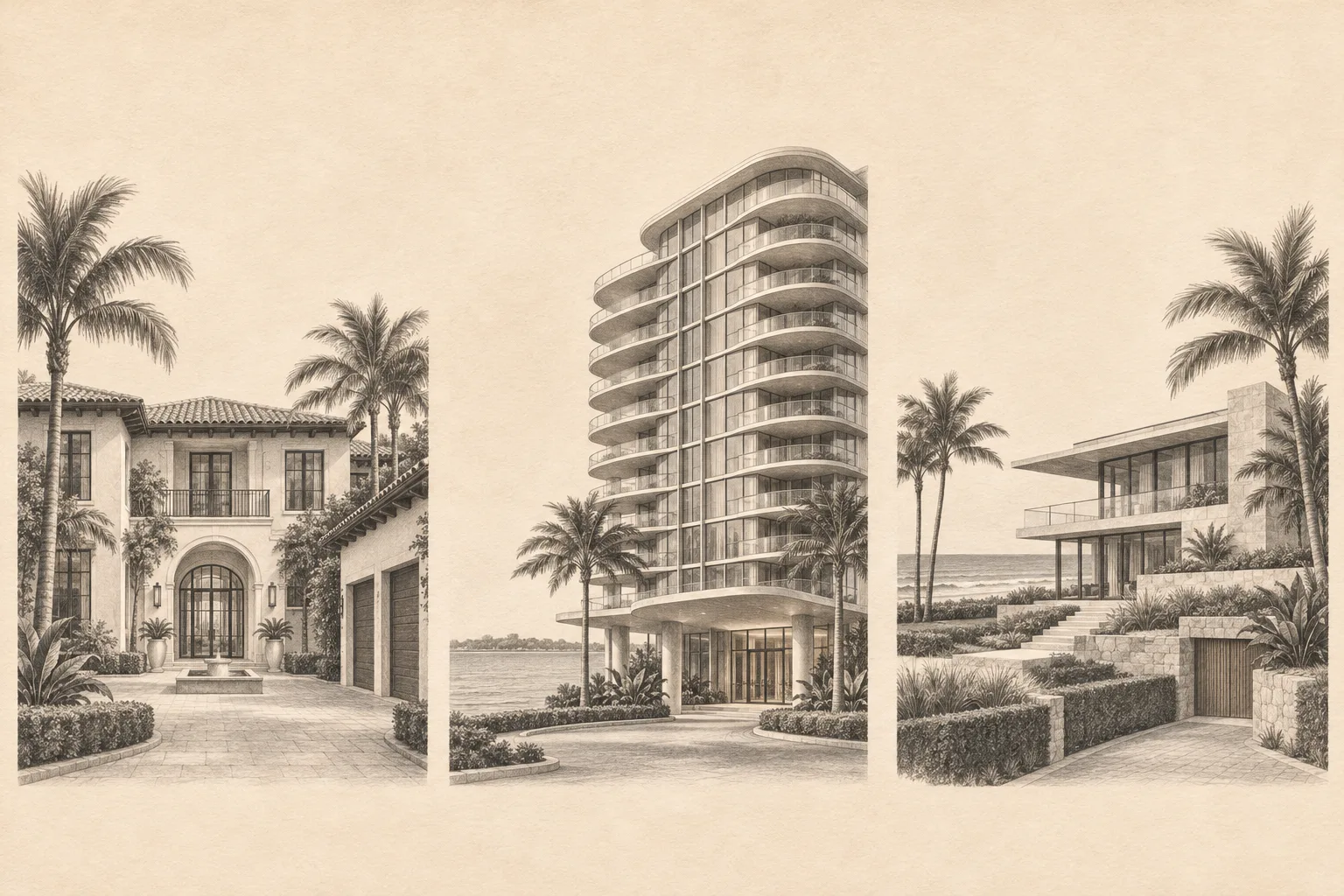
Test land, layout, and replacement cost separately
Lot position, privacy, elevation, renovation quality, garage capacity, outdoor use, and the relationship to neighboring properties may matter more than total square footage. Confirm permits, recorded interests, association obligations when applicable, and flood information for the address.
Evaluate the residence and the association together
Floor plan, view, parking, private elevator access, and service matter. So do budgets, reserves, assessments, insurance information, rules, inspections, and the building’s ability to execute necessary work. Request the current property-specific file. [3]
Separate the premium from the right that creates it
A name, marina, beach, dock, or service program may broaden demand only when the relevant rights, fees, availability, and operating terms match the property. Use our branded-residence guide or waterfront checklist before treating the feature as transferable value.
Before the property becomes a finalist
Build the document file early enough to change the decision
A document requested after the emotional decision has been made often becomes a formality. We prefer to identify the files that could remove a property from the shortlist before the final comparison.
Confirm the property being compared
Miami-Dade Property Search provides folio, property characteristics, recorded sales information, aerial imagery, and available sketches. Use it as a starting point and resolve discrepancies. [1]
Know what appears in the public record
The Miami-Dade Clerk records deeds, mortgages, liens, plats, and other instruments. An attorney or other appropriate professional should interpret documents that may affect title or transfer. [2]
Request current rules, budgets, and records
For a condominium, review the documents relevant to use and the association’s operation, including available inspection and reserve-study records. Florida’s DBPR explains the official-record categories and SIRS requirements. [3]
Distinguish inspection from reserve planning
A milestone inspection and a structural integrity reserve study answer different questions. Miami-Dade also administers a building recertification program, with jurisdiction depending on the property’s municipality. Confirm the applicable record and status. [4] [5]
Use the address, not a neighborhood reputation
Miami-Dade’s flood map tool helps identify the mapped zone for an address and provides a hotline for confirmation. A mapped zone is one input; insurance, elevation, drainage, and property condition require their own review. [6]
Do not substitute a sales presentation for governing documents
Florida law specifies disclosure requirements for condominium sales, with different provisions for developer and nondeveloper transactions. Obtain the documents required for the actual transaction and appropriate legal advice. [7]
Interactive resale evidence comparator
Compare the quality of the evidence, not a promised future price
Classify each factor for up to three finalist properties. The result identifies where the file is clear, incomplete, or constrained; it does not predict appreciation, time to sell, or investment return.
Decision resource
Use one resale-evidence matrix for every finalist
Complete the matrix with the same dates and definitions for each property. Mark an item as clear only when the evidence is current enough and belongs to the right property or comparable group.
The evidence is current, attributable, comparable, and sufficient for the decision it supports.
The answer may be favorable, but a document, definition, date, or comparable observation is still missing.
A documented condition narrows the buyer pool, raises future obligations, or changes the intended use.
| Question | Evidence to record | Why it matters | Decision |
|---|---|---|---|
| Who is the likely next buyer? | Two or three realistic buyer profiles and the features each one needs. | A feature may be exceptional yet useful to only a narrow audience. | Clear / incomplete / constraint |
| What is the comparable cohort? | Geography, format, size or segment, condition, water relationship, period, and exclusions. | Prevents a market average from replacing the actual alternatives. | Clear / incomplete / constraint |
| What has closed? | Authorized closed-sale source, dates, count, selected price measure, and material differences. | Shows completed decisions without turning past sales into a forecast. | Clear / incomplete / constraint |
| What competes today? | Active and pending comparable alternatives at one cutoff, with status definitions. | A future seller competes with available substitutes, not only past sales. | Clear / incomplete / constraint |
| Which obligations transfer? | Current fees, assessments, rules, approvals, service terms, and known scheduled work. | A future buyer underwrites the operating structure as well as the residence. | Clear / incomplete / constraint |
| What is difficult to replace? | Functional layout, land, protected view, privacy, parking, dock or beach rights, and verified service. | Specific utility is more defensible than generic luxury finishes. | Clear / incomplete / constraint |
| What could delay a sale? | Condition, documentation gaps, financing or approval questions, insurance information, and buyer-dependent work. | Friction can reduce the number of ready buyers even when demand exists. | Clear / incomplete / constraint |
| What remains unknowable? | Future rates, policy changes, new supply, buyer preferences, and personal timing. | Uncertainty belongs in the decision; it should not be hidden inside a precise score. | Accept / investigate / avoid |
Shortlist decision: keep, keep with a named condition, or remove. A high asking price, a famous address, or a recent record sale is not a fourth category.
How we use the file
The purpose is to expose trade-offs, not manufacture certainty
A property can remain the right purchase with incomplete evidence, but the buyer should know which assumption is carrying the decision. We use the same four-step sequence for every finalist.
Write the likely exit before reading the data
Is the future need a flexible sale, a long hold, a family transfer, or an uncertain timeline? The answer changes which constraints deserve the most weight.
Build the cohort without knowing the preferred conclusion
Apply the same inclusion rules to every property. Do not select comparables only because they support the asking price or the desired narrative.
Read the property file beside the market file
Match the residence, association, inspection, use, service, and flood information to the actual address and transaction.
Name the condition that could change the choice
Keep the property only when its personal value justifies the documented constraint and the remaining uncertainty.
Rare properties often have sparse comparables. That does not make them weak. It means a broad market statistic may be less useful, the valuation range may require more judgment, and the future exit may depend more heavily on timing and the specific buyer.
The same property can support different decisions
Change the evidence priority when the ownership plan changes
Protect daily utility before optionality
We would begin with layout, privacy, access, outdoor use, parking, renovation quality, and the area’s fit with the household’s actual routine. Future resale matters, but not enough to justify living in the wrong home for a decade.
Examine operation during absences
Service, maintenance, association rules, recurring obligations, lock-and-leave operation, and the ease of preparing the home for a future sale may carry more weight. Our second-home comparison develops that decision.
Confirm the right behind the view
A future boating buyer will distinguish a water view from usable access, a dock from transferable rights, and a canal from a suitable route. Verify those details before assigning value to the waterfront label.
Reduce avoidable friction
Prioritize coherent documentation, broadly useful floor plans, manageable property condition, clear ownership obligations, and a segment with understandable alternatives. Flexibility may matter more than a highly personal improvement.
Direct answers
What buyers usually want to resolve
Does a short marketing time guarantee an easy future resale?
No. One fast sale may reflect its price, condition, terms, timing, or a particular buyer. Review the cohort, sample, active competition, and property differences before treating marketing time as transferable.
Can an estate and a condominium be compared because they have the same price?
Not as direct substitutes by default. They carry different land, service, maintenance, privacy, approval, and buyer-pool considerations. Compare each inside its own defensible group, then compare the trade-offs between groups.
What if there are too few comparable sales?
Say so. Record the observations that exist, widen the period or geography only when the buyer alternatives remain credible, and make the resulting mismatch visible. Do not convert a small sample into a confident forecast.
Which South Florida neighborhood has the best resale?
There is no responsible universal ranking. Marketability depends on the property format, price segment, condition, ownership structure, timing, and the next buyer’s alternatives. Use our South Florida neighborhood guide to narrow locations, then apply this framework to comparable properties inside each finalist area.
The next action
Bring one property format and one likely exit scenario to the shortlist
Choose the areas that support how you want to live. Then define the property format, ownership horizon, likely future buyer, and the conditions that would make an exit harder. That gives the comparable review a clear job instead of asking the market to predict your future.
Compare locations first, then build the evidence file
Use the neighborhood hub to identify the areas that match your priorities. Ivan and Mike can then organize a like-for-like property review around the format you are considering.
Verification notes for property, association, and building facts
Why these links are here: our five-factor framework and recommendations organize the future-resale review. The references below have a narrower role: they verify the public tools, record categories, disclosure rules, inspection programs, and flood resources mentioned in the guide. Current documents, authorized market data, the actual property, and appropriate professional advice determine a purchase-specific answer. Public facts checked November 12, 2026.
View the public references used for factual verification
- Miami-Dade County Property Appraiser — Property Search. Address and folio search, property characteristics, sales information, aerial imagery, and available sketches; checked November 12, 2026.
- Miami-Dade Clerk of the Court and Comptroller — Official Records. Public recording and search route for deeds, mortgages, liens, plats, and other recorded instruments; checked November 12, 2026.
- Florida Department of Business and Professional Regulation — Condominiums & Cooperatives FAQs. Association official records, inspection reports, budgets, reserves, and structural integrity reserve study information; checked November 12, 2026.
- Florida Statutes §553.899. State milestone-inspection requirements for applicable condominium and cooperative buildings; checked November 12, 2026.
- Miami-Dade County — Building Recertification. County recertification process, jurisdiction notes, public-record route, and program scope; checked November 12, 2026.
- Miami-Dade County — Flood Zone Maps. Address-based map route, current and preliminary-map distinction, and confirmation resources; checked November 12, 2026.
- Florida Statutes §718.503. Developer and nondeveloper condominium-sale disclosure provisions; checked November 12, 2026.